Eusebio Vasquez Gotos was born in San Ramon, Nabua, Bicol and lived in San Manuel, Tarlac City. He was the third son of Pedro Gotos and Patricia Vasquez. It is said that his father worked on the Manila Railroad during the American Occupation. While in Bicol, he met Patricia, and together they raised a family.
Eusebio had several siblings: his eldest sister, Theodora Vasquez Gotos, married into the Gabarda family. His second brother, Sebastian Vasquez Gotos, was widowed after his first marriage, during which he had one child; however, records do not specify whether this child was a boy or a girl. He later remarried and had additional children, though details about this second marriage are less clear. Eusebio’s fourth sibling, Josefina Vasquez Gotos, married into the Juanillas family. Additionally, two daughters are said to have followed but tragically died from illness. The youngest sibling, Liberato Vasquez Gotos, married and raised a large family of eleven children.
Eusebio had a daughter, Felicitas Febie Guanzon Gotos, with his first wife, Amada Guanzon Gotos. Felicitas Febie Guanzon Gotos, the only daughter of Eusebio Vasquez Gotos and Amada Guanzon Gotos, married Roberto Sacueza. Together, they branched out the Sacueza clan in Tarlac City. After Amada’s death, Eusebio remarried Eugenia Espano Aguila, who also contributed to the growth of the Gotos clan in Tarlac City. Their third son, Manuel Gotos, married Maria Lourdes Boneo and remained in the Gotos family’s hometown of San Vicente Bato, preserving Eusebio Vasquez Gotos family legacy in Bicol.
During World War II, Eusebio played a crucial role in logistics as the Japanese invaded the Philippine islands. While he did not participate on the front lines, accounts suggest he was involved in the infamous Death March, reflecting his resilience during a challenging period in history.
Though Eusebio was known to enjoy playing dominoes and had a penchant for gambling, his true nature was that of a dedicated husband, hardworking father, and steadfast community member. His vices intensified following the tragic loss of his second son, Jose Vasquez Gotos, who served in the Philippine Reserve Command. This profound loss deeply affected him.
Eusebio Vasquez Gotos passed away on October 21, 2005, leaving behind a legacy of resilience that continues to inspire his family.
Description and symbolism:
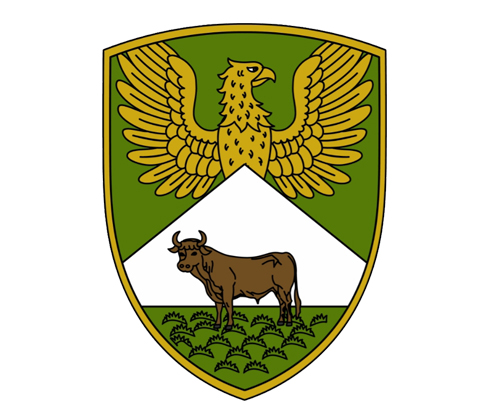
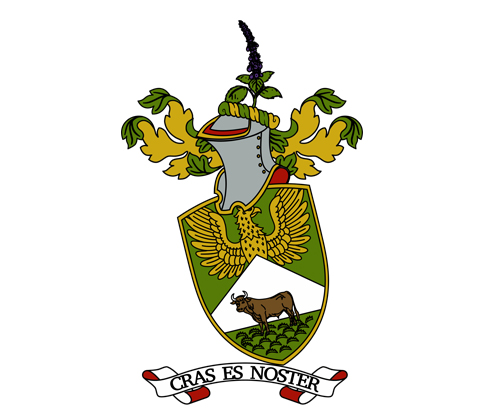
The eagle represents strength and majesty, conveying the family’s belief that even the strongest may stumble, yet those who trust in the Lord possess an unparalleled inner strength. The bull embodies the resilience of the Gotos clan, while the grassy field symbolizes fertile land and the success that follows enduring hardships. The white flag, inspired by the Philippine flag, represents equality; for the Gotos clan, it serves as a reminder that all who bear the name carry forward a legacy of resilience and strength.
In the crest, the Holy basil symbolizes purification and protection, reflecting its presence around the property of Eusebio Vasquez Gotos.
Blazon: Shield: Per chevron Vert and Argent, in chief issuant from the line of division a demi eagle displayed regardant Or, in base on a grassy mound a bull statant Proper.
Crest: A sprig of Holy basil Proper.
Motto: Cras es noster (“Tomorrow, be ours”).
Assumed/granting authority: Attributed posthumously to the Armiger by the Armiger’s grandson, Jade Michael Gotos Paez, September 28, 2024. Registered, Philippine Armorial, October 26, 2024.
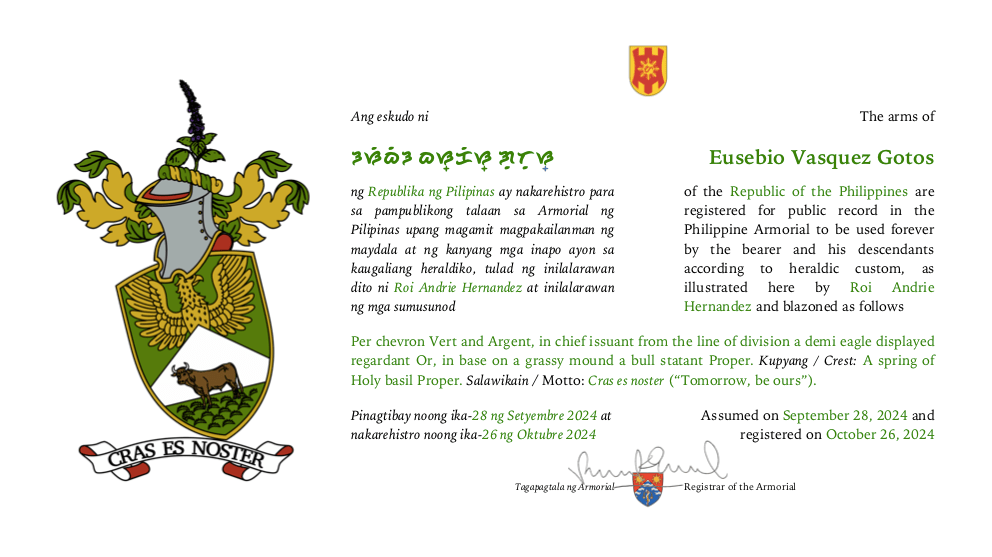
Image and information submitted by Jade Michael Gotos Paez, the Armiger’s grandson.
 Philippine Armorial