
Jerimaiah James E. Dusong is a Bachelor of Arts student in Philosophy, specializing in Law, at the University of the Immaculate Conception. He is an aspiring author and academic in philosophy and theology, and passionate for history, literature and culture. Besides being a student journalist, he has represented Our Lady of Fatima Academy of Davao, and Southern Mindanao more generally at the St. Paul’s National Bible Quiz Battle of the Champions.
He is the eldest son of Jerry and Chuchie Maribel Dusong, and was born in Davao City. Though raised a Davaoeño, his family is of Visayan heritage, with the maternal side being Waray from Leyte, and the paternal side Ilonggo from Iloilo.
Description and symbolism:
As a source of light, the flaming heart reflects the importance of faith as guidance for the Armiger. It alludes to St. Augustine of Hippo’s “August and Burning Heart” constantly seeking warmth, wealth and wisdom, and instilling a spirit that remains restless until finding rest with God. As a reference to philosopher St. Thomas Aquinas, who is commonly depicted in iconography with a sun in his heart, it also reflects the Armiger’s academic calling. The heart further recalls generally to traditional Catholicism and more specifically to the Society of St. Pius X, the priestly order and religious community from which the Armiger draws his faith; the Society uses a variation of the Twin Hearts of Jesus and Mary as their logo. Most important to the Armiger, the flaming heart represents the Sacred Heart of Jesus, as a reference to inherited family religious practice.
The eagle recalls the Philippine eagle, a symbol for the Armiger’s native land of Mindanao, and more specifically used for his hometown, Davao City, as well as his local ordinary, the Archdiocese of Davao. The Armiger values the eagle’s association with agility, swiftness and strength. As the eagle has been a recurring symbol of various empires and nations since ancient times, it alludes to his personal interest in history. In medieval Christian imagery it is also associated with St. John the Evangelist and the prophet Ezekiel: as the eagle was believed to be able to gaze directly at the sun, it is an apt allusion to receiving signs and revelations from God.
In the crest, a pelican is shown feeding her own blood to her starving chicks, a recurring heraldic reference to the sacrifice of Jesus Christ on the cross. The image is also associated with the Holy Eucharist, where the faithful receive communion that grants life anew. For the Armiger, the pelican in piety represents his dedication to faith, and receiving wisdom and mercy from God.
The motto is an ascetic principle associated with St. Louis of Montfort, alluding to the Armiger’s devotion to the Blessed Virgin Mary. Like St. Louis and countless other saints, the Armiger’s love of Jesus Christ is strengthened through the Blessed Mother. The Marian life of daily prayer of the Holy Rosary, consecration to the Immaculata and bearing of articles of devotion such as the Miraculous Medal and scapular, an Ignatian-Marian education from the Sisters of the Religious Virgin Mary, and a Marian upbringing from his family all shape the Armiger’s spirituality.
To the Armiger, the colors white represent sincerity and peace, while blue stands for loyalty and strength. Blue and white further allude to the deep seas and sandy shores of the Visayan Islands of the Armiger’s heritage. As reflections of devotion to Mary and Joseph, the colors also recall regal Marian blue and the white lily of St. Joseph symbolizing purity, and the colors of the Armiger’s alma mater to which he credits much of his early education and formation in faith.
Blazon: Shield: Per fess Argent and Azure, in chief a flaming heart Gules, in base an eagle displayed Argent beaked and armed Or langued Gules.
Crest: A pelican in her piety Argent.
Motto: Ad Jesum per Mariam (“To Jesus through Mary”).
Assumed/granting authority: Assumed, June 7, 2023. Registered, Philippine Armorial, July 7, 2023.
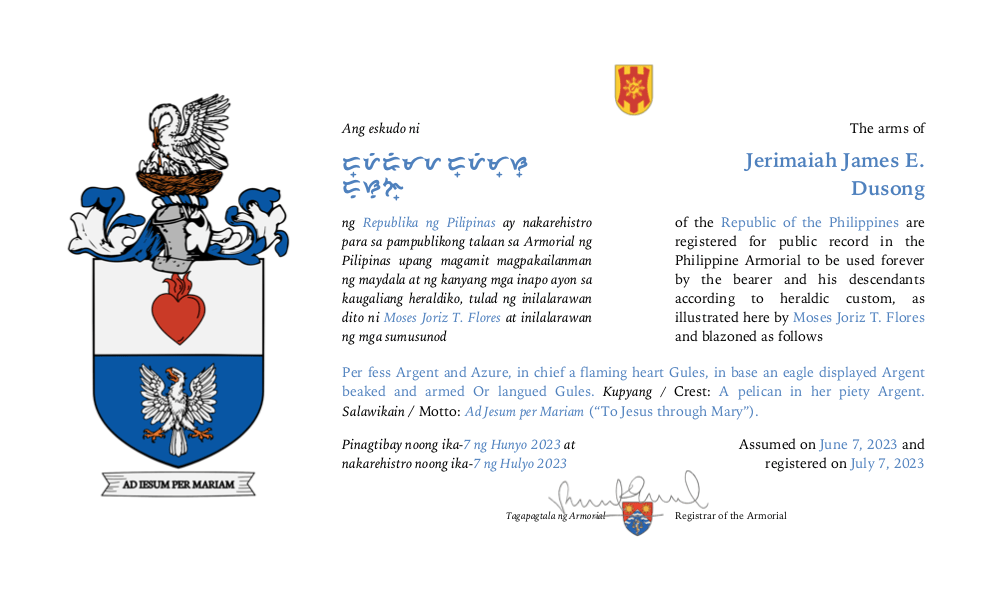
Image and information submitted by the Armiger.
 Philippine Armorial